01 / Plan & prototype
Plan & prototype
Developed original geometry through hand sketches and a cardboard mock-up.
01 / Aircraft design & electromechanical integration
Aerodynamics · Fabrication · Electronics
Designed and fabricated a fully functional remote-controlled aircraft from scratch, then integrated the propulsion, radio, and control systems into an approximately 400 g airframe.
Watch first flightSuccessful first try · More than six minutes airborne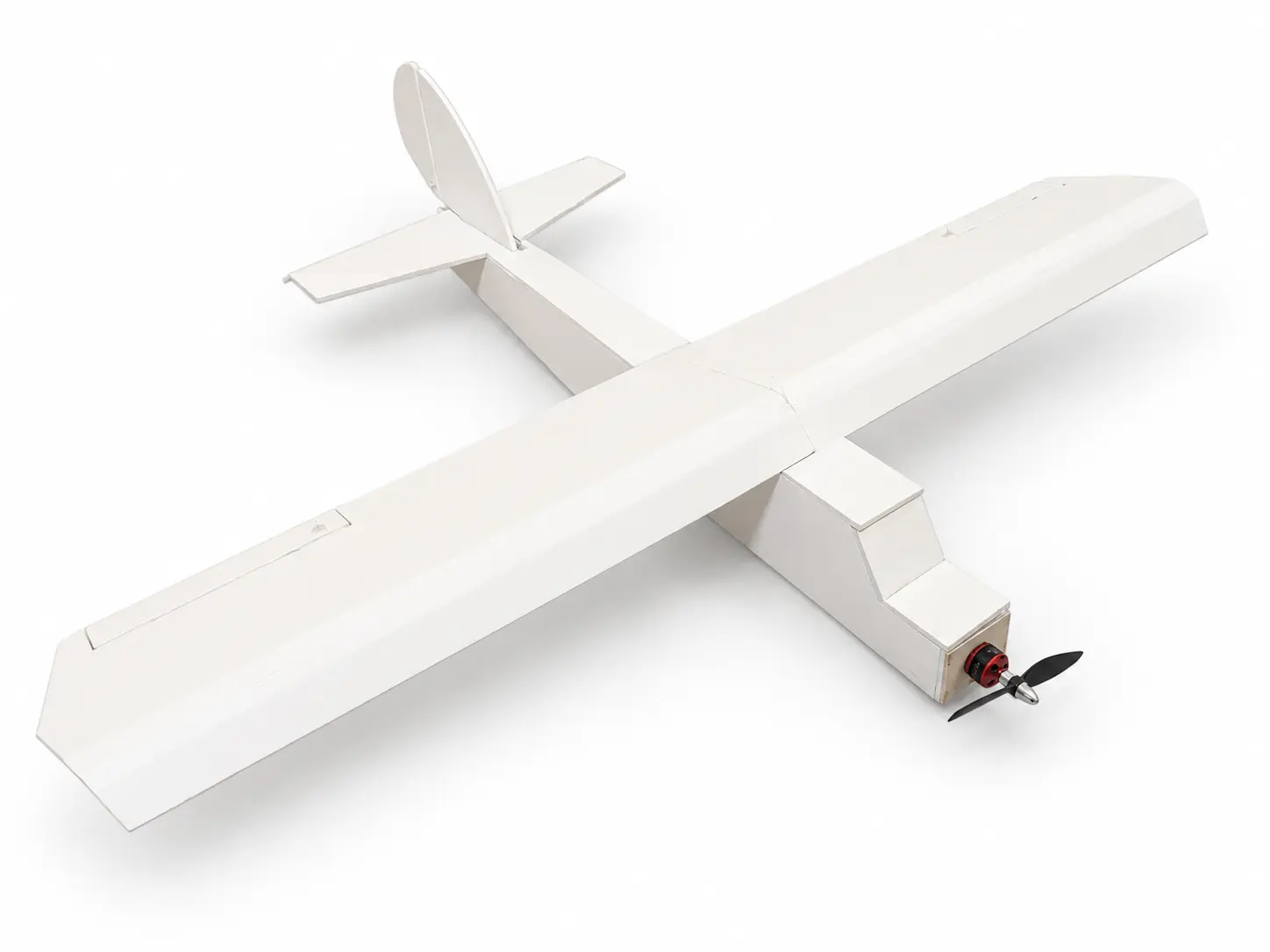
Every cut, joint, and component position affected structural strength, center of gravity, and flight performance.
The brief
Built at home in approximately 36 hours, the project challenged me to create the airframe geometry myself instead of assembling a supplied aircraft design.
I moved from hand sketches and a cardboard mock-up to a 5 mm foam-board airframe, then integrated a motor, electronic speed controller, battery, receiver, and four servos.
Achieve sufficient strength, predictable control, and a stable center of gravity while keeping the finished aircraft light enough to fly.
Prototype the geometry, fabricate the airframe carefully, use components as functional mass, and verify balance and control response before flight.
Development process
Original photographs document the project from early geometry through final control checks.
01 / Plan & prototype
Developed original geometry through hand sketches and a cardboard mock-up.
02 / Fabricate
Cut, scored, folded, and assembled the wing, fuselage, and tail surfaces.
03 / Balance & integrate
Installed the propulsion and radio systems, then positioned components to establish the center of gravity.
04 / Flight test
On its first flight attempt, the aircraft remained airborne for more than six minutes.
Engineering the details
I rejected an initial magnet concept and made custom foam interfaces that increased bonding area and created a stronger fixed wing joint.
The 3S 1200 mAh battery provided necessary forward mass. I shifted the battery and electronics until the aircraft balanced level or slightly nose-down.
A wood plate carried the motor loads, while hot glue and fiberglass tape were applied sparingly elsewhere to preserve a low flying mass.
Build notes
| Wingspan | 150 cm |
|---|---|
| Length | 112.5 cm |
| Wing chord | 20 cm |
| Airframe mass | 250 g excluding battery |
| Estimated flying mass | Approximately 400 g |
| Build time / cost | 36 hours / approximately US$80 |
5 mm foam board, a wood motor mount, fiberglass tape, hot glue, general-purpose adhesive, and metal control linkages.
BR2208 1400KV motor, 7-inch propeller, 12 A electronic speed controller, 3S 1200 mAh battery, Lemon RX six-channel stabilizing receiver, Spektrum DX6 transmitter, three SG90 9 g servos, and one 5 g rudder servo.
Mass, cost, and flight time reflect the prototype shown.
Outcome & lessons learned
The aircraft flew successfully on its first attempt and remained airborne for more than six minutes before the battery required recharging.
Designing the airframe from scratch made geometry, structure, balance, propulsion, radio control, and servo actuation one connected system. The result showed the value of careful planning, precise fabrication, and disciplined weight management.
Next project
For internship opportunities in engineering, product design, and hardware development.