01 / Ideate
Ideate
Identified the training need, sketched concepts, and compared three approaches to generating resistance.
02 / Mechanical design & fabrication
Mechanical design · Home training
Designed and built a low-cost rowing machine for home training during the pandemic, using timber, repurposed bicycle parts, and basic tools.
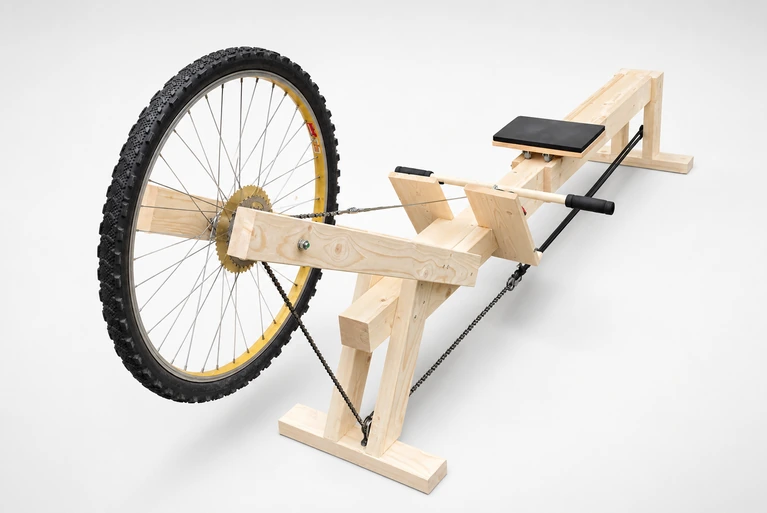
A timber frame, bicycle wheel, and chain-and-cord drivetrain form the working assembly.
The brief
During the pandemic, schools, gyms, and sports clubs were shut down. Commercial rowing machines were beyond my student budget, so I challenged myself to build a functional machine using basic tools and mostly off-the-shelf or repurposed parts.
The aim was to reproduce the motion and resistance of a rowing ergometer in a low-cost design that other students could make with readily available materials.
Create useful resistance, a smooth seat path, and a stable frame without the components or manufacturing processes of a commercial machine.
Compare resistance concepts, build a solid timber frame, and integrate a bicycle-wheel-based mechanism with a chain, cable, and elastic return cord.
Development process
Original photographs document the frame, drivetrain, and assembled prototype.
01 / Ideate
Identified the training need, sketched concepts, and compared three approaches to generating resistance.
02 / Build
Built the timber frame and rails, then made the handle, rolling seat, and angled footplates.
03 / Integrate
Connected the handle, chain, cable, and bungee cords to the wheel-and-axle mechanism.
04 / Test & refine
Used testing, including feedback from multiple users, to iterate the axle, chain arrangement, and seat.
Engineering the details
I explored air- and water-based resistance ideas before choosing a bicycle-wheel-based arrangement with a chain and bungee cord. Different cord widths and lengths helped tune the resistance using easy-to-source parts.
Seat alignment, guide-rail heights, and wheel placement all affected friction and wobble. I also tested chain-and-cord combinations to allow a full stroke with sufficient resistance.
Early testing exposed wheel shifting and rattling. I iterated ways to secure the wheel to the axle without restricting its rotation — a small connection detail with a large effect on the whole machine.
Build notes
| Length | 250 cm |
|---|---|
| Width | 45 cm |
| Height | 70 cm |
| Weight | Approximately 20 kg |
| Build cost | Approximately €150 |
| Primary structure | Solid wood beams and planks |
Timber, a bicycle wheel and chain, a steel axle, steel cable, bungee cord, miniature wheels, foam, Velcro straps, bicycle handles, carabiners, and a pulley.
Handheld saws and a jigsaw, a drill, clamps, hammers, screwdrivers, wrenches, measuring tools, sanding tools, wood glue, and mechanical fasteners.
Dimensions, cost, and weight reflect the prototype shown.
Outcome & lessons learned
I built a functional low-cost rowing machine and shared the blueprint and instructions with schoolmates during the pandemic.
The project taught me to move from an idea to a working product through repeated testing, attention to connection details, and practical choices about materials and components.
Next project
For internship opportunities in engineering, product design, and hardware development.